


Music is everywhere. At concerts, weddings, restaurants, hotels, shops, gyms, corporate events, on the radio, through streaming platforms, and sometimes simply playing in the background while we wait at an airport. But behind the music we hear are copyrights and rights holders. Understanding those rights is important because using music publicly can mean using someone else’s intellectual property.
One song can involve more than one set of rights
Music is slightly different from many other forms of intellectual property because a single song can involve different rights.
Fundamentally music involves two copyrights:
| Type of Right | What Does It Cover? | Who May Own the Rights? |
|---|---|---|
| Musical Composition | The underlying melody, musical composition and lyrics of a song. | Songwriter, composer, lyricist, publisher or other relevant rights holders. |
| Sound Recording | The specific recording of the song that you hear or play. | Performers, sound recording producer and/or music label, depending on the rights involved. |
Simply put:
One song can involve multiple rights, and those rights may need to be licensed separately.
Paying for one licence does not necessarily mean that every music-related right has been cleared.
What is a public performance right?
You do not have to be standing in front of a concert crowd for a public performance right to become relevant. Broadly, it concerns the use or performance of a musical work in a place accessible to the public, rather than simply in your own private space or home environment. The Intellectual Property Act of Sri Lanka recognises public performance rights.
The June 2026 Gazette introduced a licensing framework and licensing fees for the public performance of musical works, specifically in relation to authors, composers and publishers. It also identifies the Association of Creators and Publishers of Sri Lanka (ACPOSL) as the registered Collective Management Organisation (CMO) entrusted with administering public performance rights in musical works on behalf of the authors and composers it represents.
The framework defines public performance as a performance of a musical work in a place to which the public has access. It also separately deals with communication to the public, including making music available through means such as:
- broadcasting,
- transmission, and
- streaming.
This can potentially include music used in:
- restaurants and cafés;
- hotels and resorts;
- shops and shopping malls;
- nightclubs;
- weddings and private events;
- corporate events;
- concerts; and
- other public venues.
The key point is simple:
If music within the relevant repertoire (catalogue of songs) is being used publicly, that requires a licence and the relevant rights need to be licensed.
What is a Collective Management Organisation (CMO)?
Imagine a songwriter whose songs are being played in hundreds of restaurants, hotels, events and other venues. It would be extremely difficult for that songwriter to personally monitor every use of every song, negotiate individual licences with every music user and collect every payment. This is where collective management comes in.
A Collective Management Organisation (CMO) provides a practical way of managing this by acting as a middleman between the creator and the music user.
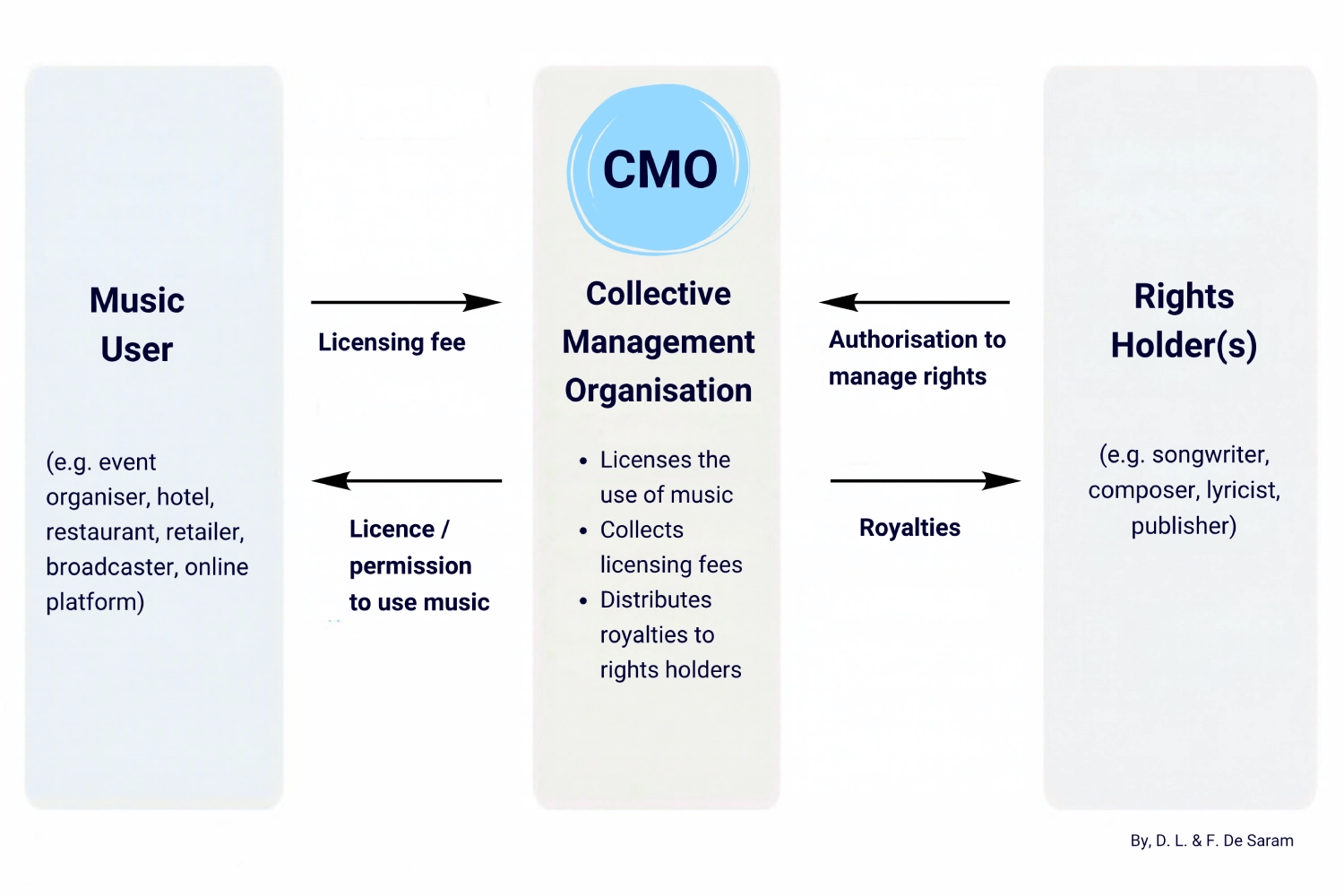
The creator authorises the CMO to administer specified rights. The CMO then licenses those rights to music users, collects the relevant licence fees and distributes royalties to the rights holders it represents.
For the rights covered by the June 2026 Gazette, ACPOSL is the CMO identified to administer public performance rights in musical works on behalf of the authors and composers it represents, which in other words means that it manages the rights associated with the musical composition copyright, and does not extend rights management to the sound recording copyright.
Importantly, a CMO can only license the rights it has been authorised to administer, meaning the licence does not automatically cover every possible right associated with a song.
Is this something new or uniquely Sri Lankan?
No. This is not new at all.
Collective management of music rights is an established practice in mature music markets, including our neighbour India. Around the world, organisations such as PRS in the UK, SACEM in France, GEMA in Germany, and Performance Rights Organisations such as ASCAP, BMI, SESAC and GMR in the United States perform similar licensing and royalty-collection functions. In India, IPRS is a registered copyright society administering rights in musical and associated literary works. The UAE has also established CMOs, including EMRA and MusicNation. The terminology and precise scope can differ from country to country where it may be called a CMO, copyright society, collecting society or PRO, administering specific rights, but the basic concept is similar. Rights holders entrust an organisation to administer specified rights, license those rights, collect licence fees and distribute royalties to the relevant rights holders.
So, the introduction of a CMO framework in Sri Lanka is not a random initiative, and neither is it the introduction of a tax, or an unlawful process. It is a recognised way of managing copyright collectively
The more useful questions you should be asking are:
- What rights are being administered?
- Who is authorised to administer them?
- What uses require a licence?
- How is the licensing fee calculated?
- And how is the money collected accounted for and distributed?
Those are the questions that matter when assessing how the framework works in practice.
What does the new licensing framework cover?
The easiest way to understand the framework is to look at where and how music is being used.
The framework covers musical works, including original musical compositions with or without lyrics and associated literary works.
Different categories apply depending on the nature of the use.
- Background music in businesses
This can include shops, supermarkets, banks, offices, showrooms, malls and cinema halls where music is played as background or ambient music. The framework also contemplates music delivered through radio, television, digital streaming and stored or physical media. - Hotels and accommodation
Hotels, resorts, guest houses, villas, lodges, homestays and similar establishments can fall within the hospitality category. This can include background music in guest rooms, restaurants, lobbies, corridors and common areas. - Restaurants, cafés, bars and similar establishments
The framework covers background music in restaurants, lounges, nightclubs, cafés, bars, pubs and similar establishments. It also provides for certain incidental live performances involving up to three performers, as well as incidental DJ use where it is not promoted or organised as an event. - DJ and live music events
Where music becomes a primary feature of an event, a different event-based licence applies. This can include DJ events, live music events, weddings, private parties and corporate events, with the applicable licensing fee depending on the relevant category and audience capacity. - Concerts
Concerts are treated separately. The framework covers the public performance of musical works at a concert, whether the music is performed live or through a combination of live and recorded elements.There is, however, an important distinction:
A public performance licence does not automatically give you the right to record, broadcast, stream or otherwise distribute the performance. Those activities can involve separate rights and permissions, which are also recognised by law in Sri Lanka and around the world. - Public spaces and transport
The framework also covers certain uses of background music in places such as airports, railway terminals, bus terminals and expressway service areas, as well as music made available to passengers through various forms of transport.
What about charities, schools and other non-commercial uses?
The framework also provides for concessionary licensing fees for certain non-commercial or socially beneficial uses. This can include eligible registered charitable organisations, educational institutions, religious institutions, community and cultural organisations, and government or municipal social initiatives. Eligibility depends on the applicable conditions, including the non-commercial nature and purpose of the use.
The important point emerging from all this is that the framework is not simply about applying one fee to every situation. The nature, scale and purpose of the use matter.
If you’re organising an event, what should you ask?
The question is not simply:
“Are we playing music?”
Instead, ask:
- What music are we using?
- How are we using it?
- Where are we using it?
- Is it background music, a DJ performance, live music or a concert?
- Whose rights are being licensed?
The applicable licensing fee can depend on these factors. This is why understanding music rights matters, particularly for event organisers, hotels, restaurants, DJs, broadcasters, businesses and others who regularly use music.
Does one licence cover everything?
No. It does not. This is probably the most important point to remember. A music licence is not necessarily a blanket licence for every possible use of a song.
The gazetted framework itself recognises that certain rights including:
- performers’ rights,
- sound recording producers’ rights
- and synchronisation rights (which arise when using music in timed relation to visuals like in music videos, commercials and films)
may fall outside the rights being administered by the CMO under this particular framework.
Therefore, depending on what you are doing with the music, additional permissions may be required. For example, publicly playing a song, incorporating it into a video, reproducing a recording and streaming a performance can involve different rights.
That is why the first question should always be:
What exactly am I doing with this music?
ACPOSL issues update on the public performance music licensing framework
ACPOSL has announced updates to Sri Lanka’s public performance music licensing framework for events, hotels and commercial premises following discussions with industry stakeholders. The association has temporarily suspended licensing requirements for weddings, private parties and DJs, pending further discussions and a final decision at its November General Meeting. Any permanent changes to the framework would require approval from two-thirds of ACPOSL’s membership. ACPOSL has also clarified that the framework applies to the commercial use of music at venues and events, and does not extend to private functions held at homes.
Why does this framework matter for the entertainment industry?
At its heart, copyright law recognises that creative work has value. Musicians, songwriters, composers, performers and producers should be able to receive fair remuneration for the use of their work. A collective licensing system makes it easier for creators to manage rights that would otherwise be difficult to monitor individually, while giving businesses and event organisers greater clarity on the permissions they need. This would also incentivise the creation of more original music by making music a more viable and sustainable profession for artists and creators.
There is also a bigger opportunity for Sri Lanka. Reciprocal arrangements with CMOs in other countries could allow Sri Lankan creators to receive royalties when their music is used overseas, while foreign rights holders can be appropriately remunerated for music used here. Over time, a reliable and predictable system can help strengthen Sri Lanka’s entertainment industry and make the country more attractive for international artists, promoters and music festivals.
In writing this article, I spoke with Mr. Ranga Dasanayake, CEO of ACPOSL, who explained that the organisation’s objective is not simply to introduce licensing mechanisms, but to develop a practical and sustainable system for Sri Lanka. He acknowledged that there will naturally be a period of adjustment as a structured copyright licensing system is implemented, and that dialogue can help improve the mechanism. When asked whether ACPOSL is open to further dialogue and discussion with industry stakeholders, he responded positively and reiterated that the fundamental principle remains unchanged: creators’ rights must be respected.
This conversation is important because a functioning music rights ecosystem should not be about creators versus businesses, or artists versus event organisers. It should be about creating a system where creators are recognised and fairly compensated, music users understand what they are required to license, and the industry has the certainty it needs to grow
FAQ’s
Potentially yes. If music within the relevant repertoire is being publicly performed at an event, the relevant rights generally need to be licensed. The applicable licence and value can depend on whether the event is a concert, wedding, DJ event, private party or corporate event, as well as the nature and scale of the use.
While licensing requirements are temporarily suspended, this should not be treated as a reason to pause preparations, businesses and event organisers should remain ready for the framework to become active again.
No. One music licence does not necessarily clear every music right. A song can involve separate rights in the musical composition and the sound recording. Public performance, recording, streaming, broadcasting and synchronisation can also involve different rights and permissions.
The music licensing requirements depend on how the music is used. Sri Lanka’s 2026 framework provides different categories for DJ and live music events, weddings, private parties, corporate events and concerts, with licensing fees depending on the applicable category and factors such as audience capacity.
The temporary suspension should not be viewed as a permanent exemption; event organisers and businesses should remain prepared for licensing requirements to resume.
The June 2026 framework identifies ACPOSL (Association of Creators and Publishers of Sri Lanka) as a registered Collective Management Organisation (CMO) for administering public performance rights in musical works on behalf of the authors and composers it represents. This does not automatically cover sound recording, performers’ or other rights.